


Last Updated: November 4, 2026
Quick Summary
A stiff fishing reel handle is almost always caused by something inside the reel, such as old dried grease, salt crystals, grit or worn bearings, rather than the rod. Clean the reel first, then re-grease only the gear teeth and check the bearings if stiffness remains.
- Old grease, salt residue, grit and worn parts are the most common causes of stiffness.
- Clean the reel before re-greasing, because fresh grease over dirt grinds again quickly.
- Use a grease for gear teeth and an oil for bearings and moving parts.
- Clicking or rattling during the retrieve points to worn bearings.
- Loosen the drag first to see whether stiffness comes from the drag washers.
Table of Contents
- Common Causes of a Stiff Fishing Reel Handle
- Diagnosing Stiffness: A Step-by-Step Flowchart
- How to Clean a Spinning Reel Before Re-Greasing
- Choosing the Best Reel Grease and Oil
- Signs of Worn Fishing Reel Bearings
- Spinning vs Baitcasting Reels: Troubleshooting Differences
- Keeping Your Reel Smooth: Maintenance and Next Steps at Fergo's
- Frequently Asked Questions
Common Causes of a Stiff Fishing Reel Handle
If your fishing reel handle feels stiff when reeling, the problem is almost always inside the reel rather than the rod. The same handful of causes come up again and again.
The most common culprits are old grease, salt residue, grit and worn parts. Each one makes the gears and bearings work harder than they should.
- Dried or hardened grease that no longer lubricates the gears
- Salt crystals left behind after a day on the water
- Sand and grit pushed into the spool and handle assembly
- Worn bearings that have lost their smooth rolling action
- Over-tightened drag or rotor components that add friction
Salt is the biggest problem for coastal anglers. Rinsing with plain tap water rarely removes it all. Instead, it can push salt deeper into the gears. A salt-removing spray such as the Cyclo SOS Spray Off Salt Premixed Formula 650ml is designed for this job, and it dries without leaving a waxy, oily residue.

Diagnosing Stiffness: A Step-by-Step Flowchart
Use this check to isolate the cause before you touch a screwdriver. Work through it in order, and stop at the first 'yes', that is your starting point.
- Does the handle feel stiff with no line on the reel and the drag backed off? If yes, the friction is in the gear train or bearings, not the drag stack. If no, go to step 5.
- Does the stiffness ease when you turn the handle very slowly, then return when you speed up? If yes, the grease has thickened or dried. Old grease channels away from the gear teeth and leaves metal-to-metal contact at speed.
- Is there grit on the spool shaft or under the rotor when you wipe it with a white cloth? If yes, clean before greasing. New lubricant over grit turns into an abrasive paste.
- Does a rough or gritty feel come with a click, tick or rattle once per handle turn? If yes, suspect a bearing race or a chipped gear tooth. A once-per-turn tick usually points to the pinion gear or the bearing under the rotor.
- Does the handle free up when you loosen the drag? If yes, the drag washers are dry, compressed or contaminated. If the handle is still stiff with the drag backed off, the problem is upstream in the main gear, pinion or handle-side bearing.
Reading Your Reel's Schematic to Confirm the Diagnosis
Most anglers guess at the part causing the stiffness. The reel's exploded schematic, usually a folded sheet in the box or a PDF on the manufacturer's site, shows every part number, shim and bearing location. Find your model number on the reel foot or body, search the manufacturer's support page for that model, and download the schematic. Match the symptom to the part: a once-per-turn tick maps to the pinion gear (often part 6xxx or 13xxx depending on brand); a constant grind maps to the main gear or the handle-side bearing; stiffness only under drag load maps to the drag washer stack.
Watch out: schematics are model- and generation-specific. A schematic for last year's version of the same reel can show a different bearing count or shim order, so confirm the generation code before ordering parts.
Quick Symptom-to-Cause Map
- Stiff from the first turn, even dry → dried grease or a seized bearing
- Stiff only after a saltwater session → salt crystallised in the rotor nut or under the spool
- Stiff and gritty → sand or grit in the gear teeth
- Stiff with a click once per turn → pinion gear wear or a failing bearing
- Stiff only when the drag is tight → drag washer stack or belleville washer order
- Stiff and the handle rocks slightly → worn handle-side bushing or a loose rotor nut
A common mistake is adding more lubricant on top of dirt. This makes the stiffness worse, not better, because the fresh grease carries grit deeper into the gear mesh.
How to Clean a Spinning Reel Before Re-Greasing
Cleaning comes before lubricating. Put new grease over old dirt and the gears will grind again within a few trips.
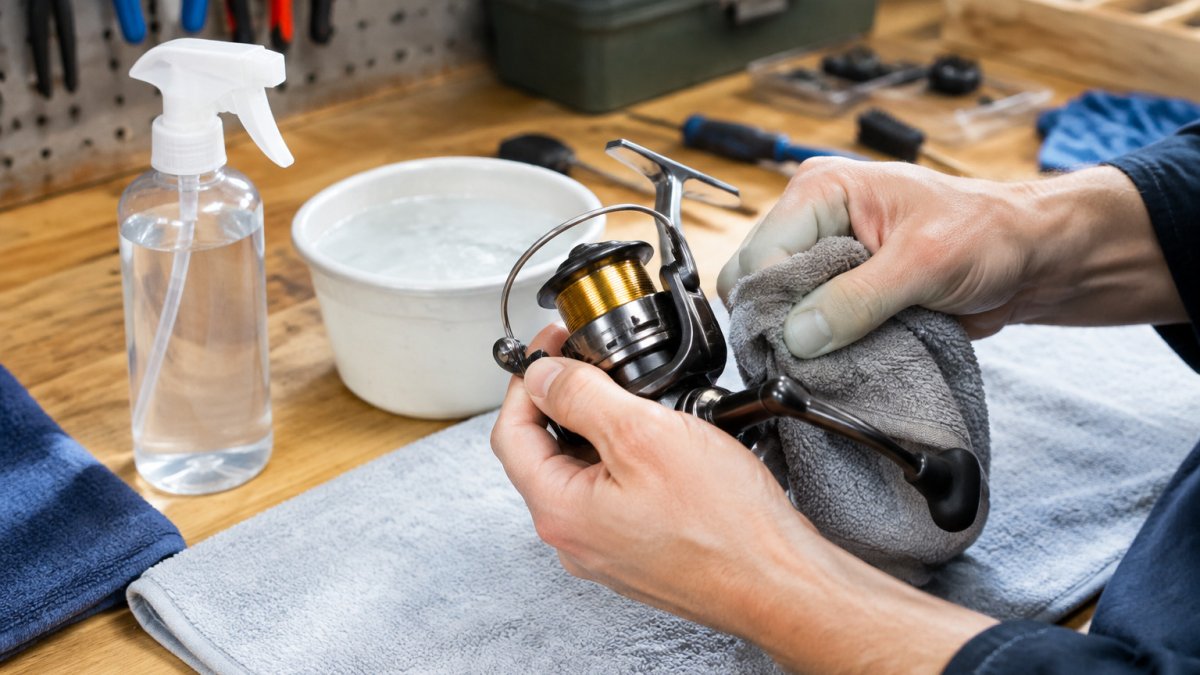
Start by removing the spool and handle. Keep the small parts in order so you can rebuild the reel the same way.
- Rinse the body with a light spray of Cyclo SOS Spray Off Salt Premixed Formula 650ml to lift salt
- Let the reel dry fully in a shaded spot
- Brush out gear teeth with a soft toothbrush
- Wipe the main gear and pinion with a lint-free cloth
- Use a Daiwa Reel Greaser to apply fresh lubricant to the gear teeth only
Do not oil the bearings directly unless the manufacturer says so. Too much oil attracts grit and causes more problems.

Cleaning steps in order, with the product the article names for each.
| Step | What to do | Product or note |
|---|---|---|
| Remove parts | Take off the spool and handle | Keep small parts in order |
| Rinse | Light spray to lift salt | Cyclo SOS Spray Off Salt 650ml |
| Dry | Let the reel dry fully | Shaded spot |
| Brush | Clean out gear teeth | Soft toothbrush |
| Wipe | Clean main gear and pinion | Lint-free cloth |
| Re-grease | Apply lubricant to gear teeth | Daiwa Reel Greaser; bearings only if manufacturer advises |
Choosing the Best Reel Grease and Oil
The right lubricant depends on where the reel is used. A reel used mostly in freshwater needs something different from one that sees salt water every weekend.
Use a grease for gear teeth and an oil for bearings and moving parts. Many anglers mix these up. Grease stays where you put it on gears. Oil spreads into bearings.
For best reel grease and oil, look for products labelled as suitable for fishing reels and marine conditions. Check the label for the reel type before buying. Ask a member of the Fergo's Tackle World team if you are unsure which product fits your reel.
Lubricant Compatibility: What Not to Mix
Mixing lubricants can cause problems. Some greases and oils do not work well together and can turn sticky or thin out. Before adding new product, wipe off the old lubricant completely. Never mix a heavy grease with a light oil in the same spot. If you are switching brands, clean the gear teeth first so the two products do not mix on the metal.
Cyclo SOS Spray Off Salt Premixed Formula 650ml →
Signs of Worn Fishing Reel Bearings
Worn bearings are a common reason a handle feels stiff. Bearings are small metal balls that help parts spin smoothly. When they wear out, the reel feels rough or sticky.
Watch for these warning signs:
- A grinding or gritty feel when turning the handle slowly
- A clicking or rattling sound during the retrieve
- The handle stopping or catching at certain points
- Rust or pitting on the bearing surfaces
Worn bearings rarely fix themselves. If cleaning and re-greasing do not help, the bearings may need replacing.
Spinning vs Baitcasting Reels: Troubleshooting Differences
Spinning and baitcasting reels share bearings and gears but fail in different places, and the fix differs accordingly. Knowing which type you own, and which sub-assembly carries the load, cuts diagnosis time in half.
Spinning Reels
On a spinning reel the handle drives the pinion gear, which turns the rotor and oscillates the spool. Stiffness usually traces to one of four places:
- Rotor nut and rotor bearing, salt packs under the rotor nut and seizes the bearing race. This is the most common cause of a stiff spinning handle after coastal use.
- Pinion gear and main gear mesh, dried grease or a chipped pinion tooth produces a once-per-turn tick.
- Spool shaft and oscillation gear, grit on the shaft adds drag through the full retrieve.
- Drag stack, compressed or dry washers make the handle feel stiff only under load.
Start with the rotor nut and pinion gear. If the stiffness persists with the spool removed, the problem is in the gear train, not the spool assembly.
Baitcasting Reels
A baitcaster carries the load through the main gear, pinion, spool bearings and level-wind. Stiffness here usually comes from:
- Spool bearings, these run dry or lightly oiled and are the first to feel rough.
- Main gear and pinion mesh, a bent main gear or worn pinion produces a heavy, grinding feel through the handle.
- Level-wind pawl and worm gear, a dry worm gear makes the handle feel stiff and notchy on the retrieve.
- Handle-side bearing, a failing bearing under the handle gives a rough feel that worsens under load.
Start with the spool bearings and the level-wind, then move to the main gear. Baitcasters are more sensitive to over-greasing than spinning reels because heavy grease on the spool bearings kills cast distance.
Which Reel Do You Have?
If you are unsure, check the reel foot for the model number, or compare the body shape against the Baitcast Reels range. Spinning reels hang below the rod with the spool facing forward; baitcasters sit on top with the spool perpendicular to the rod.
Repair or Replace?
If a full clean, re-grease and bearing check does not restore smoothness, and the schematic shows the worn part is a discontinued or costly assembly, replacement is often the better value. A rough Daiwa Spinning Reels model after a full service is a signal to compare against a newer reel rather than chase parts.
Keeping Your Reel Smooth: Maintenance and Next Steps at Fergo's
A reel that feels stiff is usually fixable. Clean it after every saltwater trip, use the right lubricant, and check the bearings each season. Rinse, dry and store the reel in a dry place with the drag loosened.
If you want to keep your reel smooth or look for a replacement, our team can help you choose. Browse our Penn Spinning Reels range, or visit one of our stores in Wollongong or Taren Point for personal advice.
Frequently Asked Questions
Why does my fishing reel feel hard to turn?
A reel usually feels hard to turn because of dried grease, grit or salt inside the gears and bearings. Salt water is the most common culprit, especially if the reel was not rinsed after use. Old grease thickens over time and can no longer lubricate the gear teeth properly. Start by checking the handle and drag for debris, then clean and re-lubricate the reel. If the stiffness remains after a proper clean, the bearings may be worn and need replacing.
How often should I grease my fishing reel?
Most anglers should clean and re-grease a reel once or twice a season if it is used regularly. If you fish in salt water, rinse the reel with fresh water after every trip and give it a fuller service more often. Reels used in dusty or sandy conditions also need more frequent attention. A simple rule is to service the reel whenever the handle begins to feel rough or gritty, rather than waiting for a fixed date. Avoid over-greasing, as excess lubricant can attract dirt.
Can salt water cause a fishing reel to become stiff?
Yes. Salt water leaves crystals on gears, bearings and the spool shaft, and these crystals grind against moving parts as you wind. Corrosion can develop over time, particularly on exposed metal components. Rinsing with plain tap water does not remove all the salt and can even push it deeper into the reel. A salt-removing spray such as the Cyclo SOS Spray Off Salt Premixed Formula 650ml, available from Fergo's Tackle World for $19.99, is designed to dissolve salt deposits and dries without leaving an oily residue.
Should I take my reel apart if it feels stiff?
You can strip a reel for cleaning if you are comfortable with small parts, but take photos at each stage so you can reassemble it correctly. Begin by removing the spool and handle, then clean the gears and bearings with a degreasing solvent suited to reels. Reapply a light coat of appropriate grease to the gear teeth and bearings. If the reel has a complex drag system or you are unsure of the layout, take it to a qualified service technician instead to avoid damaging internal components.
Fergo's Tackle World: family-owned and operated since 1960. Visit us online or in store for expert fishing advice.


