


Last Updated: November 5, 2026
Quick Summary
The best electric fishing reel for deep dropping is the one whose motor, line capacity and retrieve speed match your depth and target species, not the most expensive model on the shelf. Anglers who buy on capacity and retrieve speed tend to be happier with their setup than those who buy on looks.
- Treat roughly half a reel's rated line capacity as comfortable working depth, leaving room for drift, fights and tangles.
- The Shimano Beastmaster 9000B costs $2,015.00 and offers 25kg of Cross Carbon Drag with 900 metres of PE 8 capacity.
- The Daiwa Seaborg G1800M-RJ at $3,599.00 features two-speed gearing, 50kg of maximum drag and a Bluetooth remote control.
- Buying a reel and rod as a combo is almost always cheaper than assembling them separately and removes mismatch risk.
- Match the reel to your boat's supply rather than adding a voltage converter later, which adds heat and another failure point.
Table of Contents
- What Actually Matters When You Choose an Electric Reel for Deep Dropping
- Matching Electric Reel Line Capacity to Depth and Target Species
- Shimano Electric Reels: Beastmaster and Forcemaster Compared
- Daiwa and Penn Options for Electric Reels for Deep Drop Fishing
- Single-Speed Versus Dual-Speed and How Retrieval Speed Changes Your Day
- Electric Reel and Rod Combos: What to Pair and What It Costs
- Power, Battery Planning and the Limitations Nobody Mentions
- Talk Through Your Deep-Drop Setup With the Team
- Frequently Asked Questions
What Actually Matters When You Choose an Electric Reel for Deep Dropping
Deep dropping is fishing past 100 metres, where a 1kg sinker and bait sit on the bottom and your arms have no realistic chance of winding it back up all day. The best electric fishing reel for deep dropping is the one whose motor, line capacity and retrieve speed match your depth and target species, not the most expensive model on the shelf. Anglers who buy on capacity and retrieve speed tend to be happier with their setup than those who buy on looks.
Most guides rank reels by price and call it a day. Price tells you nothing about whether a reel will pull a 20kg hapuka from 400 metres without overheating, or whether its spool holds enough braid to reach your ledge. Below, we break down the specs that decide a deep-drop setup, compare the reels we stock side by side, and explain how to match capacity to depth so you buy once.
The Comparison Table: Specs and Prices Side by Side
| Reel | Price (AUD) | Drag | Best For |
|---|---|---|---|
| Daiwa Tanacom S300J | $999.00 | 13kg | Shallow deep reefs, handheld |
| Daiwa 23 Leobritz | $899.00 | Not listed | Jigging with electric assist |
| Daiwa 22 Tanacom 1200 | $1,099.00 | Not listed | All-round deep dropping |
| Daiwa 23 Tanacom 800 | $1,099.00 | 25kg | Mid-depth, value pick |
| Penn Fathom 30 | $1,119.00 | Variable | Boats without wired power |
| Shimano Forcemaster 9000A | $1,439.00 | Cross Carbon | Deep dropping and jigging |
| Shimano Beastmaster 9000B | $2,015.00 | 25kg | Serious deep dropping |
| Shimano Beastmaster MD 12000 | $2,339.00 | 43kg | Big fish, big depth |
| Daiwa Seaborg G1800M-RJ | $3,599.00 | 50kg | Extreme depth, remote control |
Matching Electric Reel Line Capacity to Depth and Target Species
Electric reel line capacity is the amount of braid a spool holds at a stated PE rating, and it is the first number to check. Depth plus current plus a running fish all eat line, so a reel rated to PE 6/800m does not give you 800 metres of usable fishing depth.
Species changes the calculation again. Snapper and pearl perch on 150 to 250 metres of reef suit a compact reel with lighter braid. Nannygai, red emperor, hapuka and bar cod on 300 to 500 metres need more capacity and drag. Swordfish and big tuna push you into the heavy end, where drag and hoisting force matter as much as spool size.
A pre-tied deep drop rig matched to your depth and species saves a lot of guesswork on the water, and it is the cheapest part of the setup to get right.
Shimano Electric Reels: Beastmaster and Forcemaster Compared
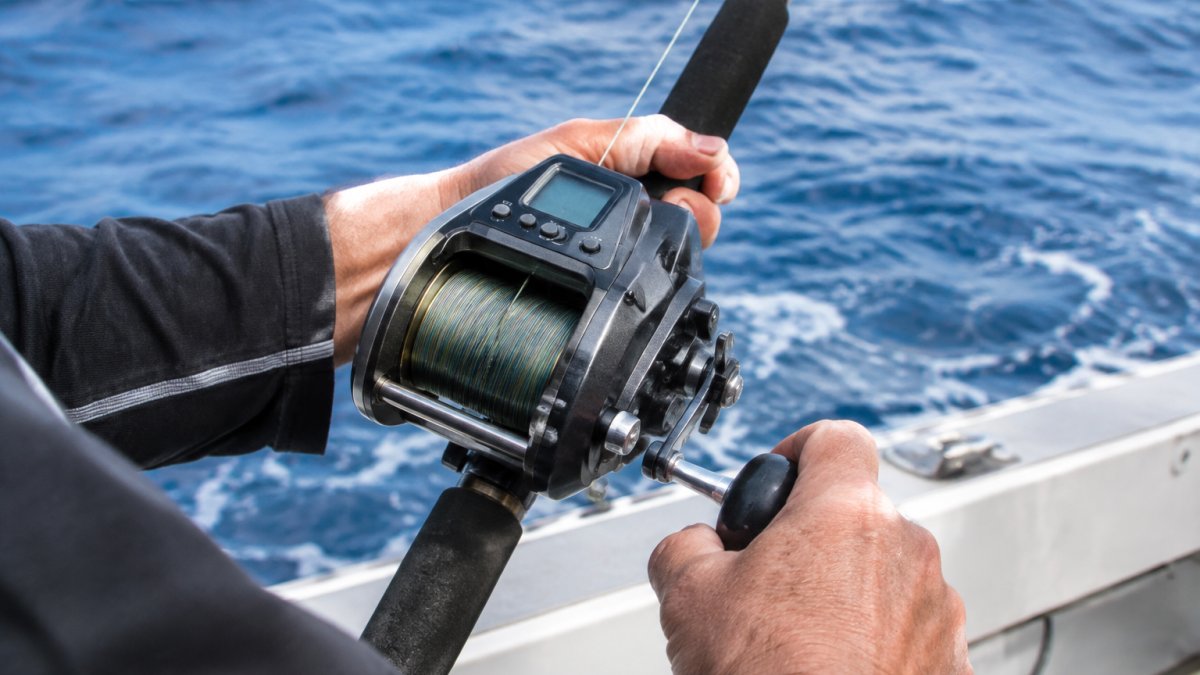
Shimano electric reels split into two clear families, and the gap between them is power rather than polish. The Forcemaster 9000A at $1,439.00 features a Muteki Motor, Cross Carbon Drag, a Heat Free System and a fine dot LCD display. It offers programmable and manual modes, covering deep dropping, jigging and kite fishing.

The Beastmaster 9000B at $2,015.00 features the brushless Giga-Max motor, 25kg of Cross Carbon Drag, Constant Speed Mode and 900 metres of PE 8 capacity.
At the top sits the Beastmaster MD 12000, at $2,339.00 bare or $2,439.00 spooled with 80lb Dog Tooth Fluidcast X8 braid. The Monster Drive system and GIGA-MAX motor deliver 2.5 times the motor torque of the standard unit, 38kg hoisting endurance and 43kg of drag. It is designed for big game species such as yellowfin tuna and swordfish, and its listing describes it as Shimano's strongest and largest reel in history.
Daiwa and Penn Options for Electric Reels for Deep Drop Fishing
Daiwa's range includes several lower-priced options. The Tanacom S300J at $999.00 is a 540g handheld reel with a BRITZ motor, 13kg of drag and a JOG Power Lever that lets you play fish like conventional gear. It is made for snapper, pearl perch, nannygai and red emperor over deep reefs and ledges. The 23 Leobritz at $899.00 takes the same compact, sporty approach with programmable jigging patterns.
Step up to the 22 Tanacom 1200 at $1,099.00 for PE 8/1,000m of capacity, a motor housed inside the spool for efficiency, and a faster retrieve that speeds up bait checks. The 23 Tanacom 800 at the same price offers PE 6/800m line capacity.
The Penn Fathom 30 at $1,119.00 runs an integrated, replaceable lithium-ion battery pack with IPX6-sealed motor and battery compartments, so it needs no cord. Its digital line counter drives an Autostop feature for hands-free retrieval.
Single-Speed Versus Dual-Speed and How Retrieval Speed Changes Your Day
A single-speed reel gives you one gear ratio, while a dual-speed reel adds a low gear for maximum hoisting force alongside a fast gear for retrieval. The difference is not cosmetic. It changes how many drops you get in a day and whether a heavy fish comes up or stalls the motor.
Retrieval speed determines how long each drop takes, and at depth that adds up over a day. Consider how many drops you want to make before choosing a reel.
Low gear is the other half of the story. When a big hapuka, bar cod or swordfish is off the bottom, the motor needs mechanical advantage, not just torque. A dual-speed reel lets you drop into low gear to break the fish off the bottom, then shift up once it is clear. The Daiwa Seaborg G1800M-RJ at $3,599.00 features a Megatorque-G motor, 50kg of maximum drag, two-speed gearing, and a Bluetooth remote control for operating the reel.
Daiwa 22 Tanacom 1200 Electric Reel →
Electric Reel and Rod Combos: What to Pair and What It Costs
Buying a reel and rod as a combo is almost always cheaper than assembling them separately, and it removes the mismatch risk. A deep-drop rod needs the backbone to lift heavy sinkers and the tip sensitivity to show a bite 300 metres down. Pair a heavy reel with a soft rod and you will struggle to set a hook; pair a light reel with a stiff rod and you will overload the motor.
The Forcemaster 9000A Status PE8-10 electric combo is listed as an electric combo with line. If you want the Beastmaster route, the Beastmaster 9000B Status PE8-10 combo with line is the equivalent build, and comparing the two side by side is the easiest way to decide. For a lighter, more jig-focused build, Shimano Tcurve deep jig rods pair well with the compact Daiwa reels.


Budget for the whole setup, not just the reel. Line, rod, sinkers, terminal tackle and a spare battery all add up, and the reel is usually the smallest part of a serious deep-drop spend.
Power, Battery Planning and the Limitations Nobody Mentions
Start with voltage. Match the reel to your boat's supply rather than adding a voltage converter later, because converters add heat and another failure point. Check the reel's stated current draw at working load, not just the no-load figure, and compare that against your house battery's usable capacity.
Cabling matters as much as the battery. Thin cable and corroded terminals cause voltage drop, and a reel that sees low voltage under load will pull more current to compensate, compounding the problem. Use cable rated for the reel's peak current, keep runs short, fuse at the battery end, and inspect terminals each season.
Cordless reels solve the wiring problem but add a charging routine. Treat cordless packs like any lithium battery: charge them before the trip, store them part-charged, and keep them out of direct sun on deck.
Heat can build up during long fights, which is why some reels, such as the Beastmaster, include a heat dissipation system and Thermo Adjust Drag Control.
Australian Maritime Safety Authority marine safety guidance is worth a read before you head wide, since deep dropping usually means travelling further offshore than a standard bay trip.
Talk Through Your Deep-Drop Setup With the Team
Choosing between a $999 Tanacom S300J and a $3,599 Seaborg comes down to where you fish and what you chase, and that is a conversation rather than a spec sheet. Bring us your typical depth, your target species and your boat's power setup, and our team can help you narrow down the right reels.
Fergo's Tackle World has been family owned and operated since 1960, we price match any Australian-based retailer, and our team gives honest advice on entry-level gear as readily as premium kit. We stock premium brands, and free shipping options are available. Get started with Fergo's Tackle World and build a deep-drop setup that reaches the bottom and comes back up without drama.
Frequently Asked Questions
How much line capacity do I need for deep dropping?
Work backwards from your deepest fishing depth, then add a generous buffer for current, drift and the angle your line sits at. A reel holding 800m of PE6 covers most recreational deep dropping, while the Daiwa 22 Tanacom 1200 steps up to PE8/1000m for deeper canyon work. Smaller hand-held units like the Daiwa Tanacom S300J carry PE3/400m or PE4/300m, which suits reef and ledge fishing rather than the deepest drops. Never spool to the brim: leave room for a smooth retrieve under load.
Are Shimano or Daiwa electric reels better for deep dropping?
Both brands make reels that handle deep water well, and the right pick depends on your depth and target species rather than the badge. Shimano electric reels such as the Beastmaster MD 12000 use a GIGA-MAX brushless motor with 43kg of drag and 38kg hoisting endurance, which suits big bottom fish and swordfish. Daiwa's Tanacom and Seaborg ranges offer strong value and features like the Seaborg G1800M-RJ's 80kg maximum hoisting force and Bluetooth remote. Compare drag, line capacity and weight for your boat before choosing.
Can you use an electric reel for other types of fishing?
Yes. Several models cover more than deep dropping. The Shimano Forcemaster 9000A offers programmable and manual modes for deep dropping, jigging and kite fishing, and the Daiwa Leobritz has programmable jigging functions for retrieving metal jigs in set patterns. The Penn Fathom 30's variable speed control and autostop suit general bottom fishing as well. If you plan to jig or fish shallower reefs, check the reel's speed range and drag before committing to a deep-drop-only unit.
What rod should I pair with an electric reel for deep dropping?
Pair the reel with a dedicated deep-drop rod rated for the same PE line class and sinker weights you plan to fish. A rod that is too light will bottom out under a heavy lead and a big fish, while an overly stiff blank reduces feel. Many anglers buy a matched electric reel and rod combo to remove the guesswork, and several reels here come with line already spooled. Ask about the rod's PE rating and recommended sinker range before you pair it.
How do you maintain an electric fishing reel?
Rinse the reel with fresh water after every saltwater trip, but avoid high-pressure spray around the motor, screen and battery compartments. Dry it fully before storage and keep the line counter and display clean so depth readings stay accurate. Check drag performance periodically and have the reel serviced if retrieval feels rough or the motor runs hot. Reels with sealed bearings and IPX6-rated compartments, like the Penn Fathom 30, tolerate spray better, but routine rinsing still extends the life of any electric reel.


